Three colours in Aztec Totem push your multiplier upward, and a fourth drags it back. That push and pull drives Aztec Totem from the first head to the last: green, yellow and red stones lift you along separate tracks, while black stones wait for their chance to take something away.
Aztec Totem comes from InOut Games and sits in the instant category: no reels spin, and no paylines need memorising. Carved heads surface one after another. Each colour keeps its own tally, and a matching trio is all it takes to nudge that colour a rung higher.
Simple on paper. The interest lies in the gaps between those rungs, because you never know what the next stone will be, and a promising streak of colour can meet dark stone without warning.
What follows moves from the inside out. Paths come first, then the black head and its burn rule, then collecting, bonuses, the published numbers, access and safer habits. None of it promises profit. Think of it as a map of how Aztec Totem actually behaves.
Multiplier paths in Aztec Totem
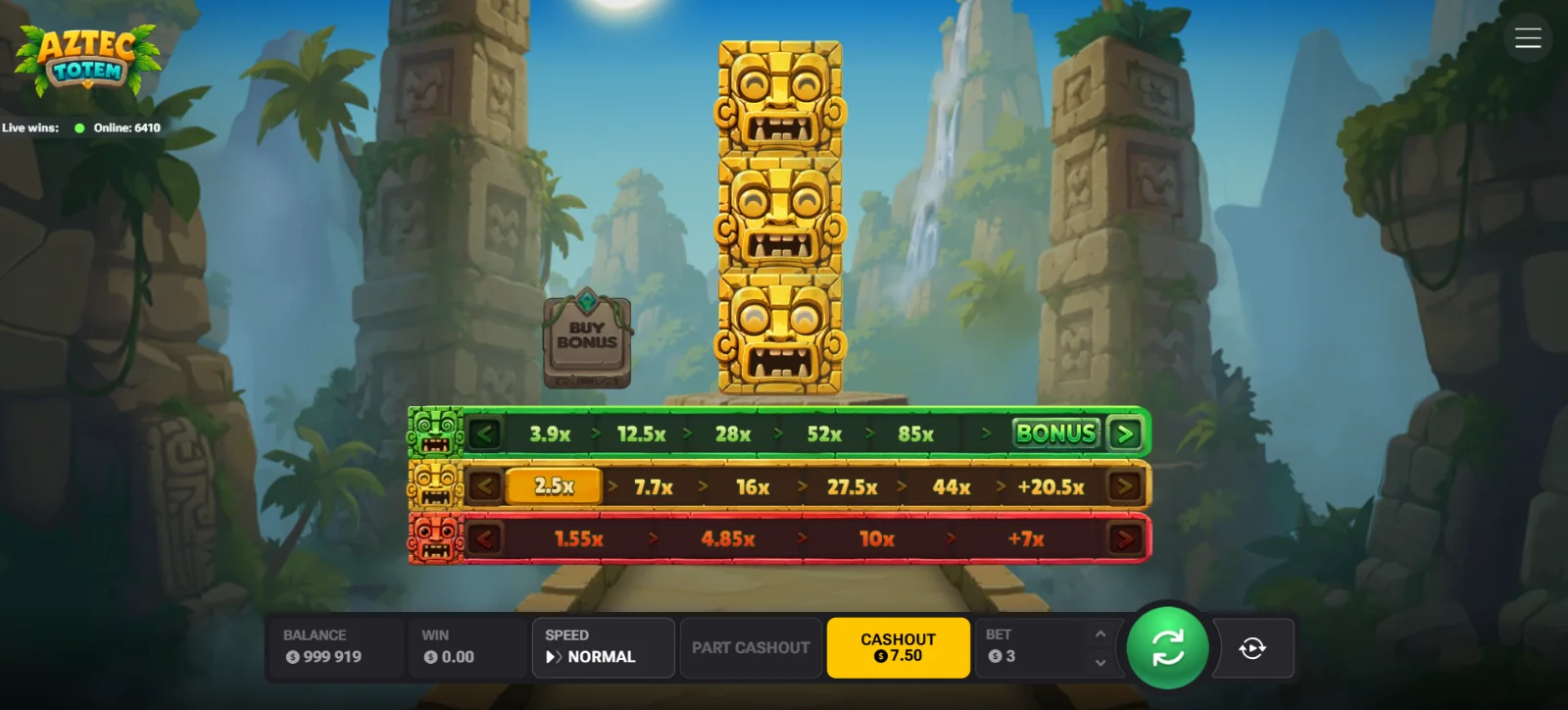
Picture three ladders side by side, one painted green, one yellow, one red. Every carved head either belongs to one of them or joins the black group standing apart. Coloured heads are tallied per colour, and the tally only matters in threes.
Three greens and the green ladder rises by one rung. Three yellows lift the yellow ladder instead, and red behaves just the same. No colour borrows progress from another, so a single round can look lopsided, with one ladder well advanced and the others hardly begun.
That separation gives Aztec Totem its pulse. Rather than a lone spin settling everything, the round unfolds as a chain of small events: a fresh stone adds to a tally, completes a trio, or feeds the black count.
InOut Games publishes no fixed value per rung, and none is suggested in these sections. The public frame is wider: a 95.55% RTP for the standard build, a high volatility rating, the stake range and a 150x ceiling. Whatever a ladder can pay sits inside that frame.
Since every stone is random, a filling ladder shows your current position, never the colour of the next arrival.
The green path
Green holds a special place among the climbing colours. It moves the same way as the others, one rung per trio of green stones. The difference is where it leads.
Get green all the way up and a bonus round begins. It hands you a multiplier drawn at random, while the Free Multiplier Spins attached to it arrive in a quantity chance alone fixes. Since neither figure is set ahead of time, two players who both finish the green ladder may walk away with very different results.
Plenty of players therefore track green quietly while the rest of the round plays out. A green tally close to completion can feel weightier than the other two, purely because of what sits at its summit.
Even so, green answers to the same randomness as every other colour. Nothing lets you coax more green onto the screen, and no earlier sequence makes green likelier next time. Black stones can cut into a green climb exactly as they cut into yellow or red.
Treat the green bonus as a possibility woven into the design, never as a goal worth funding beyond your plan.
The yellow path
Yellow runs on the familiar count of three. Each completed yellow trio lifts that colour's multiplier by a level, and the yellow ladder keeps a record untouched by green or red.
No rung-by-rung table exists for yellow in the published material, so no single yellow level is given a number in these lines. The useful knowledge is behavioural. Yellow may jump repeatedly while its neighbours stall, or it may barely stir for a long stretch.
Whatever yellow has gathered counts toward what you can take home when you stop. A healthy yellow position can therefore be a perfectly reasonable cue to collect, even with green far from its top.
The red path
Red rounds off the trio of climbing colours. Its rule mirrors the other two: three red stones push the red ladder up one rung, and nothing on yellow or green alters that.
As with yellow, individual red levels carry no published values, and making some up would only mislead. The structure is what counts. Red owns a ladder, rises in rungs, and faces the black-head rule just as much as its neighbours.
Some rounds lean on red when the other colours are sluggish. Other rounds see red hardly at all. Both patterns are ordinary in a high-volatility game where every stone is drawn at random.
If red has carried you somewhere you are pleased with, stopping is always allowed.
Black heads in Aztec Totem
Black stones counterbalance everything described so far. They sit outside the three ladders and never push a multiplier up. Their role is to claw ground back.
Here the rule is brief. A third black stone burns the latest multiplier on your climb. Your newest gain, in other words, disappears the instant that dark head lands, so the black tally merits as much attention as green, yellow or red.
This changes the feel of a round. A climb is never fully safe while you remain in it, because dark stone can always come back. With two blacks already showing, you are a single head from losing your latest rung, and randomness gives no clue as to when that head will turn up.
Beyond the burn itself, the published rules of Aztec Totem describe nothing more about what follows, so nothing more is claimed here. For your choices, the core effect is what counts: black costs you the newest multiplier.
Some players file black stones under pure bad luck. A more useful lens treats them as the price of staying in. Each additional stone you hold out for offers another shot at a rung and another opening for black to bite. Your decision to collect is how you weigh the two.
How paths and cash-out connect
Any Aztec Totem round travels from stake to decision in a set order. Here is where the ladders and the collect option meet.
- Choose a stake. The smallest wager the game knows is A$0.2 and the largest is A$330, though every operator sets which slice of that span it actually offers.
- Launch the round. Carved stones start arriving one by one, each one coloured green, yellow or red, or else black.
- Follow the colour tallies. Any trio of one colour moves that colour a rung higher on its own ladder.
- Count the dark stones. With three blacks in, your most recent multiplier is burnt.
- Decide whenever you like. Take everything, carry on, or bank a share through Partial Cashout as the rest keeps running.
- Mind the green summit. Should green reach its peak, the bonus arrives, bringing a chance-drawn multiplier together with Free Multiplier Spins in unforeseeable supply.
- Finish on your own terms. Collecting settles the result, and whatever comes after owes nothing to it.
Two of these steps reward a second look. Step 5 has no deadline, so the timing is entirely yours. Step 4 can strike at any moment, which is why waiting always carries a cost.
Before your first real wager, open the help or rules panel of the copy you have loaded. Configurations can differ between casinos, and that panel shows exactly what governs your version.
Partial Cashout and full collection
While a round runs, Aztec Totem lets you respond in three ways. Their differences, set out plainly:
- Full cashout. You bank the entire current amount and the round closes. Black stones can no longer reach it, though any further climb is gone too.
- Partial Cashout. Some of your winnings get secured, and the rest is left running. The banked part is safe; the live part keeps riding the ladders and remains open to the burn rule.
- Carrying on. Nothing is collected yet while you wait for more heads. Every ladder stays open for progress, and everything stays exposed to black.
- Planning ahead. Fixing your collection point before the round starts makes these calls calmer in a game where stones land quickly.
- Two blacks on the board. Many players lean toward a full cashout here, since one more dark head would wipe out the newest rung.
- No reward for lingering. Collecting early is never penalised and staying late earns nothing extra; the real question is simply what you want to keep.
Free Multiplier Spins and Bonus Buy
Aztec Totem offers two separate routes into its spin-based extras. You earn one in ordinary play; the other you simply pay for. Both lead to additional spins, yet they differ in access and price.
Green-path bonus
The earned route runs up the green ladder. Completing it opens a bonus carrying a randomly drawn multiplier and an equally random allotment of Free Multiplier Spins. Both are fixed only at that instant, so no standard bonus size can be quoted.
Because green depends on randomly drawn stones, nobody can schedule this feature. Some rounds reach it; plenty never do. Treating it as a welcome surprise rather than a target protects your budget, because pursuing a feature is a classic route to overspending.
Bonus Buy
With Bonus Buy, the climb is skipped. A payment worth 100 times your stake secures a free-spin package in Aztec Totem whose size falls on a figure from 10 up to 25 spins, and no black stones appear in them. With no dark head around, the burn rule has nothing to act on.
The price is the fact to weigh most carefully. Spending a hundredfold stake is a heavy commitment next to a single round, and the player has no control over whether the package lands nearer 10 or nearer 25. High volatility applies here as well, so a purchase can easily return less than it costs.
Certain casinos restrict or exclude purchased features, and some leave the option out altogether. Promotional bonus funds may also count differently toward wagering, may be barred from particular games, and usually carry a maximum bet chosen by that casino. Check those terms before pairing a promotion with Bonus Buy, and only buy when the full price sits comfortably within your session budget.
Maximum win and stakes in Aztec Totem
Aztec Totem caps any single result at 150x the stake. The ceiling holds however a round plays out, whether the value comes from the ladders, the green bonus or purchased spins.
An illustration shows how the cap scales. Staking A$4.9, the 150x maximum win would come to A$740. Take that purely as an example of the arithmetic. No ladder rung is worth that amount by definition, and nobody should count on reaching it.
The full stake span stretches between A$0.2 and A$330. The limits on your screen depend on each casino's own settings, so one operator may show a narrower band than another. If a preferred stake is missing, the casino's configuration is the cause, not a fault in the game.
Picking a stake is less about the ceiling than about your budget. A size that allows the number of rounds you intended is usually wiser than one chosen because the top prize looks tempting. Long quiet runs are normal under high volatility, and a smaller stake gives your funds more room to absorb them.
Settle on the stake before you begin, and resist raising it mid-session to recover losses. That habit tends to drain a balance faster than any single outcome.
RTP and game volatility
The standard build of Aztec Totem carries a 95.55% RTP. That percentage reflects how much of all wagers flows back to players across an extremely long run of play. Your own session could land well above or well below it.
Operators may opt for an alternative configuration, meaning 95.55% is not universal. Whatever percentage applies to you is printed inside the help screen of the copy you open; a quick look settles it.
Volatility is rated high. Results can therefore swing sharply: several rounds might return little before one climbs well. The flip side is that a budget can shrink fast when the swings run against you.
Neither RTP nor volatility can forecast the next stone. Rounds are independent, so a long spell without green says nothing about whether green is due. History simply does not carry forward.
InOut Games and Aztec Totem
InOut Games is the studio behind this release. Aztec Totem launched in October 2026, borrowing its look from the ancient Aztec civilisation, with carved stone heads at the heart of play.
It runs on the studio's Twist mechanic. Instead of spinning reels, Twist uncovers heads singly, and the order in which they arrive shapes the round. That is why the game feels more like a string of small decisions than a classic slot spin.
InOut Games creates and distributes the title, while licensed online casinos host it and look after accounts, deposits and withdrawals. InOut Games does not accept bets from players directly. Questions about payments, limits or your account belong with the casino.
Demo and devices
Aztec Totem has a free demo, paid for in virtual credits, on numerous casino sites. Its rules match the paid game, which makes it a sensible place to see how often trios form and how the black rule feels in motion. Whether a demo is present varies by casino; one operator may list it while another does not.
Those credits are worth nothing in cash. Demo winnings cannot be withdrawn, and demo losses cost nothing, so treat it as practice rather than a preview of real results.
Built in HTML5, it opens directly in a mobile or desktop browser with nothing to install. Treat any app or APK file that presents itself as the game, or as a key to some special edition, with deep suspicion.
Phone players benefit from a steady connection that keeps quick rounds smooth, and a compact screen can make a black stone easy to overlook.
Casinos offering the game
Real-money Aztec Totem is reserved for licensed online casinos whose catalogues include InOut Games, and for players aged 18 or older. Before registering, confirm that the operator shows a valid licence and accepts players from where you live.
Getting started is usually brief: open an account, pass identity checks, fund it, then browse the instant games section until the totem appears.
Steer clear of unlicensed sites, signal groups and so-called predictors. No bot, app or channel can forecast the next stone.
Responsible gaming
Time slips by easily in Aztec Totem. Stones land fast, decisions pile up, and an hour can pass unnoticed. Fixing a budget and a session length before you start draws a firm line that the game's pace cannot smudge.
Licensed casinos commonly provide deposit and time limits among their account tools. Switching them on is a practical move, not an admission of trouble. Self-exclusion is there too for anyone wanting a longer pause.
Take regular breaks. A short step back resets your thinking, above all after a burnt multiplier or a loss that tempts you toward a bigger stake. Chasing losses is among the habits most likely to turn play into a problem.
Keep in mind that each round is random. Earlier stones reveal nothing about later ones, and no system can assure a profit.
Once gambling has stopped being entertaining, or has begun weighing on your finances, sleep or relationships, reach for support from a professional help organisation, where trained advisers deal with exactly this. Seeking support early is a sensible step, not a sign of failure.
An honest look at the game
Expect high volatility from Aztec Totem, and know that a third black stone will burn the newest multiplier you reached. Bonus Buy costs a hundredfold stake, a hefty outlay for a spin count that lands randomly from 10 up to 25.
The 95.55% RTP refers to the standard build, and the copy at your casino might differ, so read its rules. No result can exceed 150x the stake. Nothing guarantees a win, and no tool can predict the next head.